Can AI read a historical record without rewriting it?

A family-history question became an experiment in transcription, evidence, and the cost of being confidently wrong.

3,505 pilot entries59 offline testsUncertainty retained
01

A family question became a systems problem

The Apcar Chronicle is my family-history project. It follows an Armenian diaspora family from New Julfa, the Armenian quarter of Isfahan in present-day Iran, into the trading worlds of the Indian Ocean, South Asia, Southeast Asia, and East Asia. Different branches built lives and businesses in places including Calcutta—now Kolkata—Hong Kong, Japan, and Java, in present-day Indonesia.

My own line connects to Hong Kong under British colonial rule through my great-grandfather, Arratoon Vertannes Apcar, who founded A. V. Apcar & Co.; my grandfather, George Armen Apcar, who was born there; and my mother, Patricia, who spent part of her childhood there. These are people and places I am trying to understand, not just names to extract.

The Hong Kong Jurors Lists offered a recurring record of names, occupations, employers, and addresses. Published annually by the government, they listed men eligible for jury service, divided into Special and Common jurors. They were a selected administrative population, not a census—and being listed does not prove someone served on a jury.

The 1854–1941 series spans 88 years and 1,769 pages. Our working reference inventory contains roughly 98,000 annual entries across 87 retrieved years. That is a provisional count, not a verified census or a count of distinct people: the same person can appear year after year.

I wanted to follow those appearances: a change of employer, a move, a different spelling, a name that disappears. And I wanted to see whether it could be done with AI—accurately, affordably, and without quietly rewriting the evidence.


02

The work that came before

Gwulo—“Old Hong Kong”—is a community history website founded and run by David Bellis. Its readers share photographs, documents, memories, and knowledge of the city. Family researchers, local-history enthusiasts, and people tracing old buildings and businesses all have reasons to use it.

In July 2010, Bellis asked volunteers to help turn the juror-list scans into searchable, sortable text. The project began long before today’s widely accessible conversational and image-reading AI. It finished in June 2026: 1,769 pages covering 1854–1941, over nearly 16 years. HKU had already made scans and limited search available; Gwulo made the contents much easier to find and use.

In the original discussion, Bellis asked for exact transcription with one explicit exception for accents and umlauts. I use Gwulo as a cross-check after reading the source. The three 1940 examples below show what that check can reveal. Gwulo’s original project discussion.

Example 01 / A printed abbreviation · Scan page 2

One extra letter changes what the record says

Original scan

Ngan Shing-kwan’s printed occupation ends China Motor Bus Co., Ld.

Ngan Shing-kwan’s occupation ends with “China Motor Bus Co., Ld.”

Gwulo record

View on Gwulo ↗
Gwulo lists Ngan Shing-kwan as Managing Director, China Motor Bus Co., Ld.

Gwulo keeps “Ld.”

Our pilot output

The occupation also ends in “Ld.” One model check expanded it to “Ltd.” A reader still recognizes the company, but the extra letter changes the printed wording. A comparison that overlooks such edits can make two readings appear to agree.

Ngan Shing-kwan | Managing Director, China Motor Bus Co., Ld. | 64 Kennedy Road.

Example 02 / Two people on consecutive rows · Scan page 63

Two names on consecutive lines

Original scan

First printed row: Rolfe, Claude Hamilton, merchant at C. H. RolfeNext printed row: Rome, Louis de, engineer at H.K. Electric

Claude Hamilton Rolfe is the merchant at C. H. Rolfe. Louis de Rome, the engineer at H.K. Electric, appears immediately below him.

Gwulo record

View on Gwulo ↗
Gwulo’s consecutive entries for Rolfe, Louis de and Rome, Louis de

Gwulo incorrectly lists the merchant as “Rolfe, Louis de” and lists the engineer as “Rome, Louis de” on the next line. A search for Claude Hamilton Rolfe can miss the merchant’s entry.

Our pilot output

The agentic transcription pilot records “Rolfe, Claude Hamilton,” as the merchant at C. H. Rolfe and “Rome, Louis de” as the engineer at H.K. Electric. Both match the printed rows.

Rolfe, Claude Hamilton, | Merchant, C.H. Rolfe | On premises.Rome, Louis de | Engineer, H.K. Electric Co., Ld. | 205 King's Road, Flat 7.

Example 03 / A readable name held at export · Scan page 42

A readable name, still held at export

Original scan

Leung Tin-wai, clerk at American Express Co., Inc., 223 Jaffé Road, top floor

Leung Tin-wai is listed as an American Express clerk at 223 Jaffé Road, top floor.

Gwulo record

View on Gwulo ↗
Gwulo’s name cell reads Indeed Tin-wai after Ting-kau

The name field reads “Indeed Tin-wai after Ting-kau.” The occupation and address are still there, but a search of Gwulo’s page for his full name can miss him.

Our pilot output

The pilot preserves the occupation and address and exports the name as [UNRESOLVED]. Both the baseline and the final AI reviewer read “Leung Tin-wai.” The reviewer marked it confirmed and said the worn print was clear enough to read.

It entered that observation in the uncertainty field, and the export holds any name with text in that field. That is how a readable name ended up on hold. The crop and saved decision give a human reviewer or a more capable model the evidence to check the reading against the print.

[UNRESOLVED] | Clerk, American Express Co., Inc. | 223 Jaffé Road, Top floor.

The Gwulo crops show the name, occupation, and address columns as captured on 9 November 2026. The pilot excerpts show the same three fields from the saved export.

Original 1940 scans, HKU Libraries

03

The structure is part of the evidence

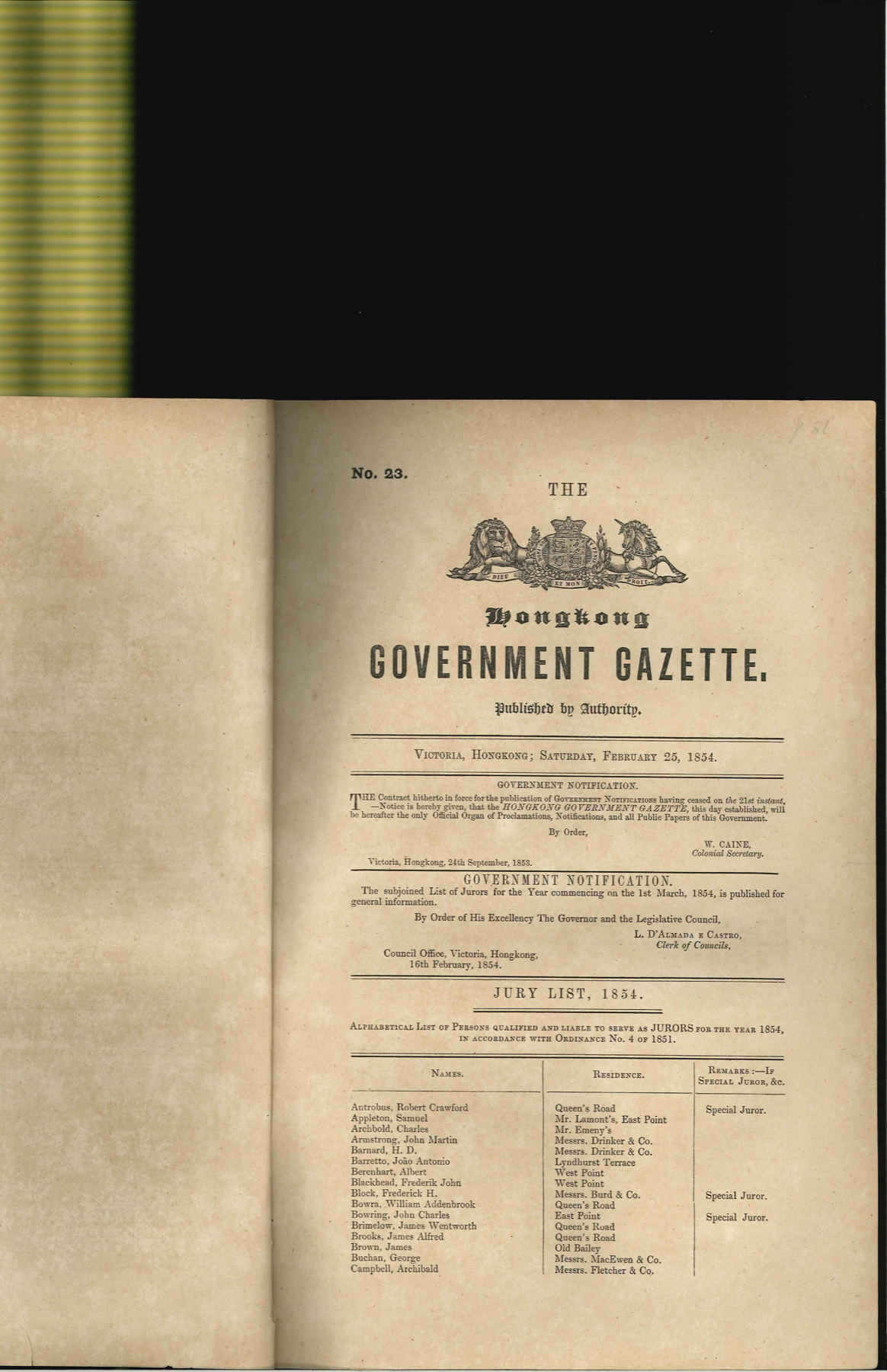
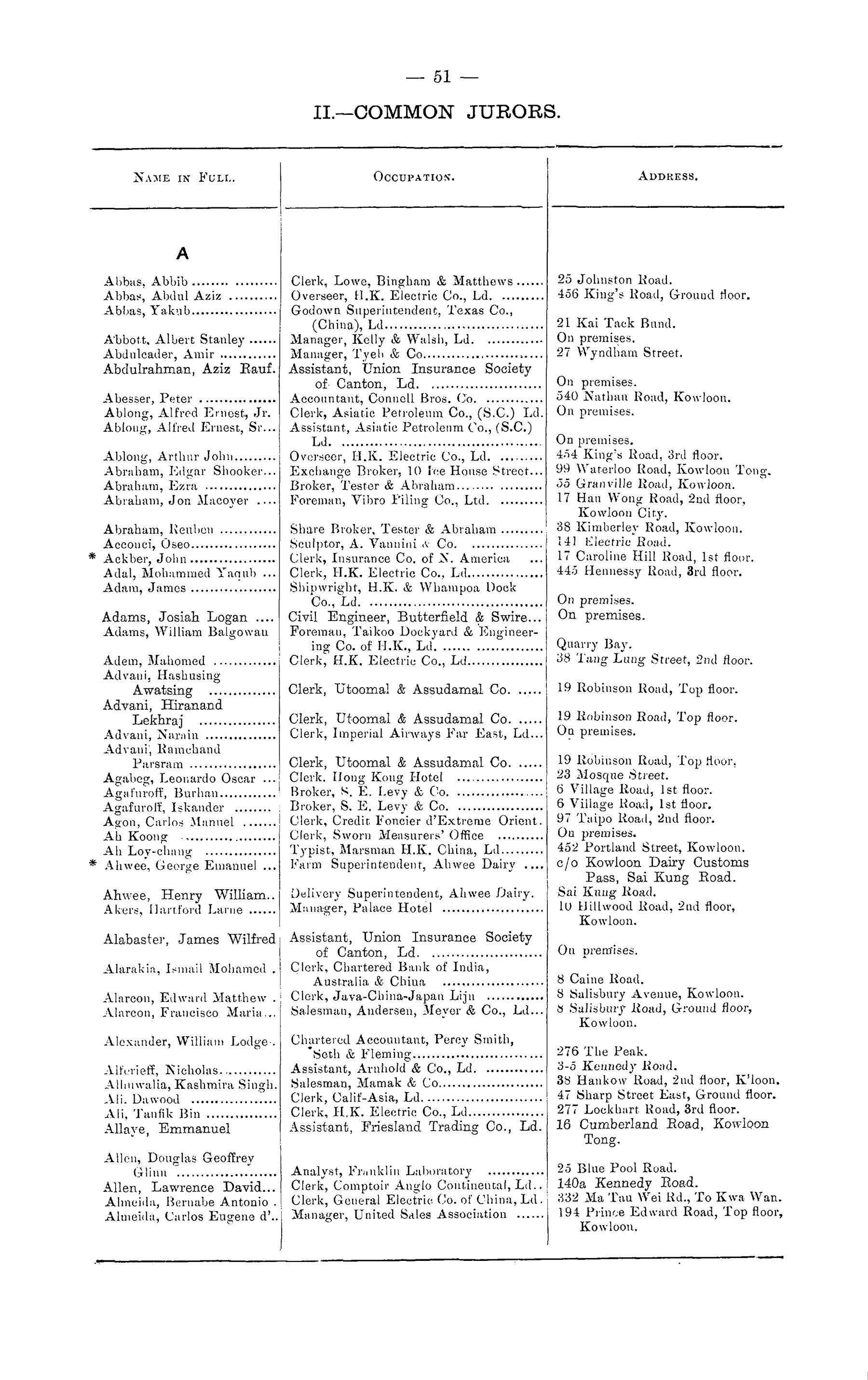
These are printed entries, not handwritten ones. The book photograph and sheet below show the problem: old type, uneven reproduction, columns, abbreviations, accents, and small marks. The handwritten page annotation on the 1854 book is incidental.

A row describes a person, but may occupy several printed lines. A name can wrap; an address can continue below it; leader dots bridge gaps between columns. Reading the words is only half the job. The name, occupation, and address must remain attached to the right person.

1854 printed Gazette page with a handwritten page annotation near its upper-right margin
1854 witness: printed entries and a handwritten page annotation. Source: HKU Libraries. Source exhibit; excluded from the code package.
1940 Common Jurors table with columns for full name, occupation, and address
1940 pilot: names, occupations, and addresses in a typeset table. Source: HKU Libraries. Source exhibit; excluded from the code package.
03A

Why “just run OCR” is not the whole job

A first pass can extract a lot of useful text cheaply. Ours did. The challenge is finding what looks convincing but is wrong: a faint letter, an unfamiliar name made familiar, an address assigned to the next row. A narrow crop can remove the evidence before the model sees it.

We tried different readers, blind rereads, informed adjudication, stricter prompts, reference comparisons, and crop repair. One repair run re-cropped 576 of 3,505 entries for width or skew. Some remaining holds—entries not cleared for acceptance—came from conservative edge rules or failed calls, rather than unreadable text.

These selected cases show how failures happen, not how often. Click any strip to inspect the retained source crop.

1940 · page 17 · entry 32 · audit disagreement

A plausible correction can erase evidence

Printed entry for Chu Wah-fong with Shamsuipo in the address
The scan prints “Shamsuipo.” Flash supplied the conventional “Shamshuipo.” The later source review supported preserving the printed spelling. A modern search alias may help, but it must not replace the literal address.

1940 · page 2 · entry 39 · original hold

Italic print, a wrapped name, and an unresolved address

Printed Stanton entry with italic Tien Ping Shan address
“Tien Ping Shan” is italic type, not handwriting. The name wraps across lines, and leader dots separate the columns visually. The retained hold register still marks the abode uncertain after informed adjudication. This image illustrates the reading problem; it does not establish which particular mark originally triggered the hold.

1940 · page 3 · entry 13 · original hold, repaired crop

Readable words still need correct row boundaries

Printed Abraham entry with a wrapped Kowloon City address
This is the repaired crop of an original held entry. The address wraps onto a second line, with fragments of the next row at the lower edge. Its retained disposition remains uncertain in name, occupation, and abode. A readable phrase alone does not settle its exact transcription or ownership.
03B

Small changes, different consequences

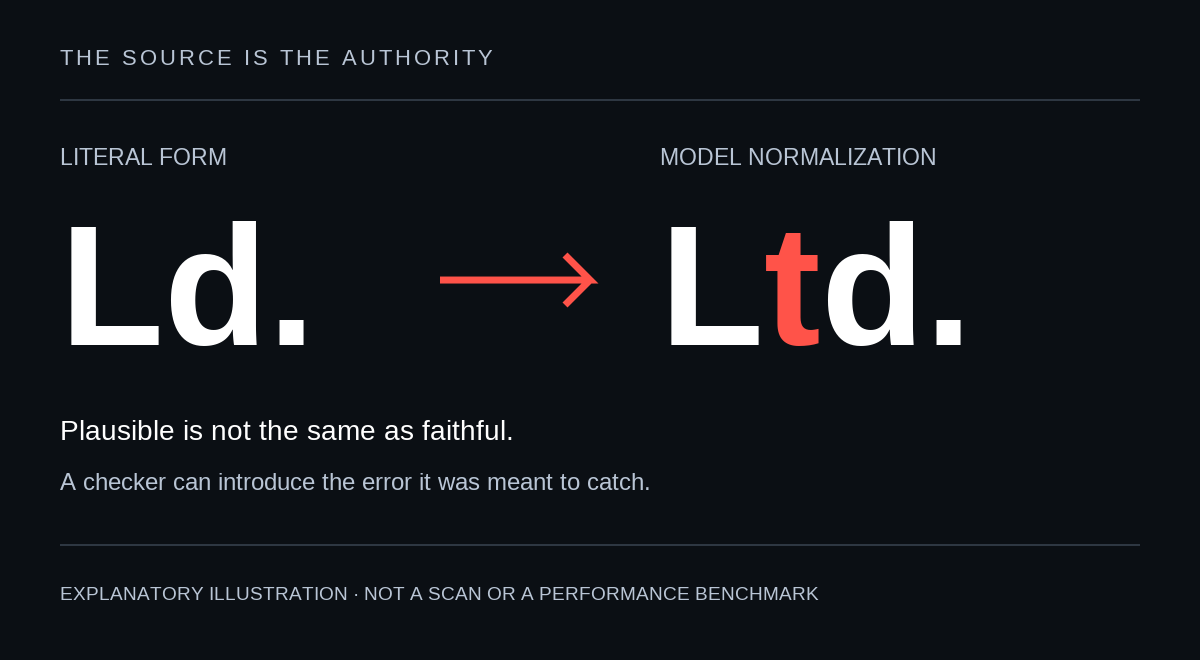
“Ld.” becoming “Ltd.” may preserve the intended meaning while losing what the page says. If the checking rules ignore the difference, apparent agreement can overstate what was verified.

A changed name or place spelling can affect searches and links across years. A row error can attach correctly read words to the wrong person—suggesting a move, employer, or family connection the source never recorded. Those are downstream risks, not outcomes proved for every example here.

The practical answer is to keep literal text, source images, and review history together. Normalized spellings and search aliases belong in separate fields. You can make the material easier to find without erasing the evidence.

04

The models did not fail in the same way

Flash made the first large-scale reading economical. It also made some text more conventional than the source. In selected checks, unusual printed names and words became familiar spellings. When a reference transcription made the same change, agreement concealed the problem.

Qwen provided another reading, while Pro served as an informed tiebreaker in the earlier workflow. That distinction matters: a model shown the competing answers is adjudicating, not contributing another blind witness.

A cheap Haiku reread found disagreements, but also introduced them. It expanded Ld. to Ltd. and altered punctuation. The checker could introduce the very errors it was meant to catch. Our comparison rules compounded that by ignoring some marks.

Sonnet with a stricter prompt retained more literal detail on a selected hard-case comparison. It still added or dropped punctuation and sometimes treated leader dots as text. That was a useful result for choosing a route, not a universal model ranking: model and prompt changed together, and the comparison was neither a representative sample nor independent human ground truth.

The orchestration failed too. A Gemini benchmark continued issuing requests after credits were exhausted: the corrected record contains 243 billing errors among 246 calls. That tells us nothing about the blocked model’s reading quality. It tells us the workflow needed a global billing stop.

Illustration showing Ld. changed to Ltd.; plausible text can differ from literal source text
Original explanatory illustration. Not a source facsimile or a benchmark.
05

What changed in the system

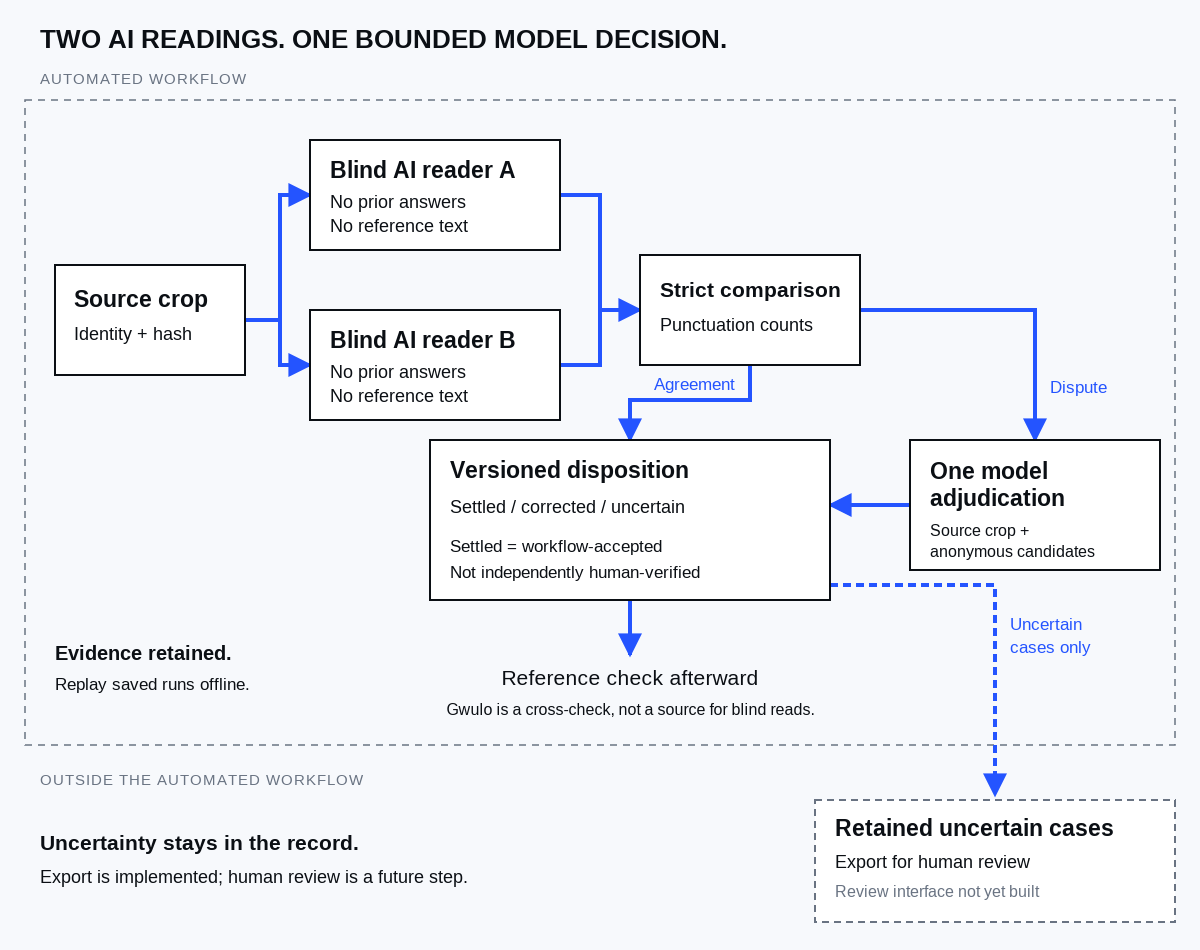
The resulting harness gives models narrow jobs. Two readers see the source independently. Strict comparison retains punctuation and accents. Unresolved fields form one deduplicated queue. A single informed adjudication can choose either reading, neither, or leave uncertainty. Gwulo enters afterward as a reference flag.

Python controls the sequence, spending limits, and stopping rules. Every completed compatible request can be reused. Changes to the image, candidates, prompt context, or material settings must invalidate stale results. An interruption must not turn a paid call into an invisible cost or silently repeat it.

This is a custom harness: software that gives models bounded jobs, preserves their evidence, and controls what happens next. The aim is a result someone can inspect.

Two blind AI readers feed strict comparison and one model adjudication. Settled means workflow-accepted, not independently human-verified. Reference checks follow decisions, and uncertain cases are exported for future human review outside the automated workflow.
Disputes receive one model adjudication using the source and anonymous candidate readings. “Settled” means accepted by the workflow, not independently human-verified. Uncertain cases are retained for future human review; the harness exports them, but the review interface is not yet built.
06

What the 1940 acceptance test actually proved

“Acceptance” here means a defined engineering check: could the new harness preserve an existing edition, retain the evidence behind it, resume after interruption, and reproduce the output? It does not mean every transcription was certified correct. The 1940 acceptance exercise migrated 3,505 pilot entries without changing the retained edition: 3,058 settled, 84 corrected, and 363 uncertain. It preserved 10,988 historical reading variants and 497 informed decisions. All 95 original holds were accounted for. The 33 Special entries on page 1 remain excluded, so this is not a complete-year edition.

Five deliberately chosen real-source cases exercised comparisons, decisions, and release construction using retained evidence. An interrupted import resumed cleanly. Both releases reproduced byte-for-byte with network access refused. That exercise made no new paid transcription calls; the earlier readings and the development work were not free.

The accepted harness had 58 passing offline tests. Publication preparation exposed a history-scanner defect, reproduced it with a failing test, and corrected it. The code draft now passes 59 offline tests.

07

More than one year—and different kinds of progress

This proves migration and mechanics on retained real evidence, not perfect transcription. The review is model-based, with no independent human labels against which to measure its true error rate. Full original request settings are missing for 6,547 imported reading variants. The remaining gap inventory contains 363 uncertain entries and 925 resting on weaker evidence.

I directed the research question, source standards, workflow, acceptance criteria, and iteration. AI coding and review agents helped implement, test, and challenge the software. The development history retains that assistance and the repairs. My interest is in whether the system earns trust under inspection.

This project has already worked across multiple years. The distinction is between earlier source-reading work and acceptance of this new harness. Completing one does not automatically prove the other. This is a build in public, with a working artifact and visible limits.

1906: the local production record covers all 16 matched Gazette pages and 962 entries, retaining seven held fields. 1908: accepted local production contains 942 entries, with 39 held fields across 37 rows. These earlier productions have their own source-review records; they were not produced by the new harness.

1940: 3,505 pilot entries passed the new harness’s migration and replay acceptance, with the stated coverage and accuracy limits. 1939: the latest retained local checkpoint, at 3:11 p.m. Central on 8 November 2026, records the second reader in progress. Inventory work also exists for 1938 and 1941. Those snapshots are evidence of work underway, not completed-year or harness-acceptance claims.

08

What the earlier attempts taught us

The custom harness came after document-conversion tools, local OCR models, general-purpose agents, and hosted readers. They were useful experiments, and sometimes useful production tools. None removed the need to check the structure and the evidence.

An early Docling test reported successful conversion on all three pages, but failed our selected 18-record structure check: columns were concatenated, addresses detached, or people combined. Later reconstruction using page geometry improved the result. The software’s success flag did not mean the records were intact.

On a 1908 page, we also tested PaddleOCR-VL and a community 4-bit olmOCR configuration. Correcting olmOCR’s input resolution produced a table, but 59 candidate rows appeared against 56 reference records. Source inspection found an address assigned to the wrong person and wrapped names split into rows. These were specific configurations and small tests, not rankings of entire projects.

A project-configured OpenClaw workflow produced a useful 942-row supplemental 1908 package and resolved its own 53-field hold queue. It also left a separate set of identifiers and decisions to reconcile with the accepted production. Some intermediate receipts lacked render hashes or token and cost totals. That experience argued for tighter task controls, not a blanket verdict on OpenClaw.

General agents helped investigate and build. For the repeating job, I wanted stable source IDs, fixed stages, explicit spending limits, reusable results, and release checks enforced in code.

09

What comes next

Prove the next year. Finish and reconcile the 1939 readings, then take them through the harness’s evidence, interruption, and replay checks. Report coverage, uncertainty, and spending separately.

Improve the weakest evidence. Revisit uncertain fields, strengthen entries resting on weaker readings, and account for omitted pages. Preserve unresolved cases. Independently measured accuracy still needs a properly designed reference audit; another model reading is not ground truth.

Test transfer. Use an unseen year or different layout. Compare total cost per accepted entry, including checking and repair. A cheap reader earns its role by meeting the quality bar; difficult cases move to a stronger route or remain held.

Make the output useful. Provide source-linked records, separate search aliases, versioned corrections, and reproducible examples. The next researcher should be able to inspect a finding without inheriting my entire workspace.

10

Beyond historical records

This is the same class of problem as turning invoices, contracts, or personal paperwork into records people rely on. A supplier attached to the wrong invoice line, an obligation assigned to the wrong party, or a date attached to the wrong family member can matter more than an obvious unreadable word. Those are applications of the lesson, not systems demonstrated here.

The model reads and proposes. The harness defines what must stay literal, what may be inferred, when to stop, what evidence to retain, and how to check the result. Models can change without changing those obligations.

For repeated document work where errors matter, that is the approach I would take: models chosen for specific jobs, with task-specific controls around them. It need not mean building everything from scratch. OCR engines, workflow platforms, and general agents can all be components.

I started because I wanted to know more about my family. I kept going because getting a plausible answer was much easier than getting one I could trust. Building the machinery to tell the difference became the project.

+

Acknowledgments and sources

Thanks to David Bellis and the contributors to Gwulo’s Jurors Lists project, and to HKU Libraries for access to the historical source material. Gwulo is a reference cross-check. The comparison above shows short excerpts from the entries discussed. No partnership or endorsement is implied.

The code and original documentation are available under MIT in the linked GitHub repository. Historical source images and the family photograph are separate, attributed exhibits; they are not covered by the code license.

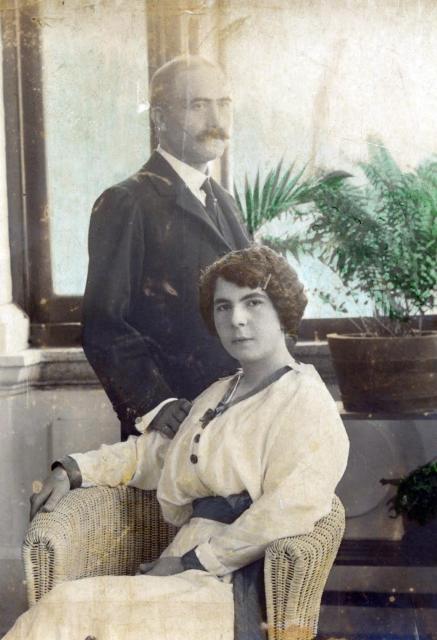
Arratoon Vertannes Apcar standing beside Ashken Apcar, seated at Ava House

My great-grandparents, Arratoon Vertannes and Ashken Apcar, at Ava House, Hong Kong, probably in the early 1920s. Family photograph I shared on Gwulo.

Back to the family question.

The photograph is from the 1920s. These entries are earlier: the Hongkong Government Gazette of 23 February 1906. They show my great-grandfather and a named assistant in his firm, each with 45 Wyndham Street in the abode column.

Printed page 197, centre row: Arratoon Vertannes Apcar, merchant, A. V. Apcar & Co.
Printed page 201, centre row: Tigran Matthew Gregory, “Asst. A. V. Apcar & Co.” The affiliation is stated in the source.

Two entries do not tell the whole story. They give me names, roles, an address, and a place to look next.

Source: HKU Libraries, 1906 Gazette witness. Select a strip to see its full page. Arratoon’s Gwulo profile includes my correction to his birthplace.